
Patient transport equipment is one of those procurement categories that rarely gets attention until something goes wrong. A stretcher that fails under load, a cot that cannot lock into its vehicle mount, or a frame that puts staff in repeated poor posture positions does not make headlines until it causes an incident.
For procurement managers, facilities directors, and clinical operations teams, understanding what separates fit-for-purpose transport equipment from inadequate alternatives is genuinely important, and the decisions made at the buying stage have consequences that play out over years of clinical use.
The range of products in this category is wide. Basic flat-top stretchers, fully adjustable hydraulic cots, bariatric platforms, stair chairs, and patient transfer boards each serve different purposes within a healthcare operation. Getting the right product for a specific role requires more than reading a specification sheet.
Why Stretcher Quality Directly Affects Staff Safety
Manual handling injuries are among the most persistent occupational health problems in healthcare. Paramedics, nurses, and patient transport staff perform the same loading and unloading movements many times per shift, often in cramped spaces, on uneven ground, and with patients who cannot assist their own transfer. Equipment that does not support those tasks with good ergonomics accumulates harm gradually, through the kind of repetitive strain that builds into chronic injury rather than a single incident that generates a report.
Height-adjustable stretchers and cots with powered loading systems address this directly. When a cot can raise itself to a working height that reduces spinal loading, and when a loading mechanism assists rather than opposes the act of lifting the patient into the vehicle, the cumulative physical toll on the crew is meaningfully lower. Services that have introduced powered loading systems consistently report reductions in musculoskeletal sick leave, which offsets the higher initial cost within a few budget cycles.
For services evaluating options, suppliers like Stretchers R Us offer the Ferno product range, which has a long track record in emergency medical services and is worth using as a quality benchmark when assessing alternative products.
Ambulance Cots Versus Hospital Transport Stretchers
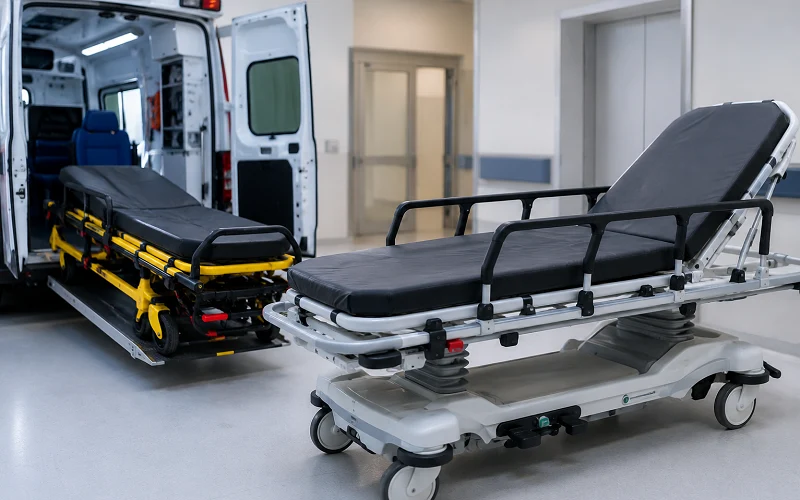
These two product types are often conflated but have different design requirements. An ambulance cot must lock securely into a vehicle’s mounting system, withstand road vibration across a working life of many years, be operable efficiently by a crew of two in a confined space, and deploy and retract quickly under time pressure. Weight capacity ratings and the compatibility of the locking mechanism with specific vehicle platforms are the first things to verify before purchase.
A hospital transport stretcher has a different brief. It needs to be highly manoeuvrable in corridors, compatible with radiology tables and operating theatre transfer boards, easy to clean to infection control standards, and stable enough for patients who may have IV lines or monitoring equipment attached. Some products serve both environments adequately; most serve one better than the other.
Bariatric capacity is a consideration that applies to both categories. Patient weight distributions have shifted in most healthcare systems, and transport equipment rated only to standard capacity creates gaps in service capability that are genuinely difficult to work around in an emergency.
Procurement Checklist
Buying stretchers and cots without a structured evaluation process often leads to decisions that look reasonable on paper but create operational problems in use. Before committing, it is worth confirming vehicle compatibility with every make of vehicle in the current fleet, verifying that the stated weight rating matches the realistic patient population the service encounters, checking that spare parts and servicing are available domestically without long lead times, and reviewing real-world references from services running the same equipment at comparable volume.
Total cost of ownership, including expected service intervals, replacement part costs, and the staff training required for new equipment, gives a more accurate financial picture than the purchase price alone.
Frequently Asked Questions
What is the standard weight capacity for ambulance cots?
Most standard cots are rated to around 180 to 200 kilograms. Bariatric models are available with ratings of 300 kilograms or higher and should be specified whenever the service area includes a significant bariatric patient population.
How often should stretchers be serviced?
Most manufacturers recommend preventive maintenance every six to twelve months depending on usage intensity. High-frequency ambulance operations may require more frequent inspection of locking mechanisms, hydraulic components, and frame integrity.
Are powered loading systems worth the cost?
Evidence from services that have adopted them consistently shows reductions in manual handling injuries among crews. The saving in sick leave costs and injury compensation typically recovers the additional purchase cost within a few years.
How do I verify that a cot is compatible with my vehicles?
Check the cot’s mounting system specification against the mounting rails installed in your vehicles. If in doubt, request a physical fit trial before committing to a fleet order.
What hygiene standards should stretcher mattresses meet?
Mattress covers should be fluid-resistant and able to withstand the cleaning agents used in your infection control protocol. Avoid covers with seams or recesses that trap moisture, and check that the material is rated for the specific disinfectants your service uses.