Every other industry has already gone through its custom-software wave. Finance built its own trading stacks in the 1990s. Logistics rebuilt around bespoke route-planning engines in the 2000s. Retail quietly replaced a decade of monolithic point-of-sale platforms with composable systems in the 2010s. Healthcare, by contrast, has spent most of that time living inside a small number of vast, general-purpose electronic medical record systems that every clinic, hospital, and specialty had to bend itself around.
That era is ending. The combination of open APIs, FHIR adoption, and modern cloud infrastructure has made it realistic for healthcare organisations to build or commission software that actually fits their workflows. For anyone who follows enterprise technology, it is one of the more interesting late-cycle shifts happening right now.
Why Legacy EMRs Left Such a Large Gap
The big EMRs were built to solve a specific problem at a specific scale: large hospitals needing a single source of truth for clinical data, billing, and regulatory reporting. They did that well. What they did less well was adapt to the long tail of specialty clinics, outpatient groups, telehealth providers, urgent care operators, and digital health startups that emerged after the platforms were designed.
Anyone who has sat next to a clinician during an average charting session understands the cost. Templates full of irrelevant fields. Screens that assume a scheduled visit when the real one is a walk-in. Billing configurations that require a side quest to capture a telehealth modifier correctly. The software works, but it taxes the clinician every time they touch it.
The Rise of Composable Healthcare Infrastructure
Three technology shifts have made a different approach possible.
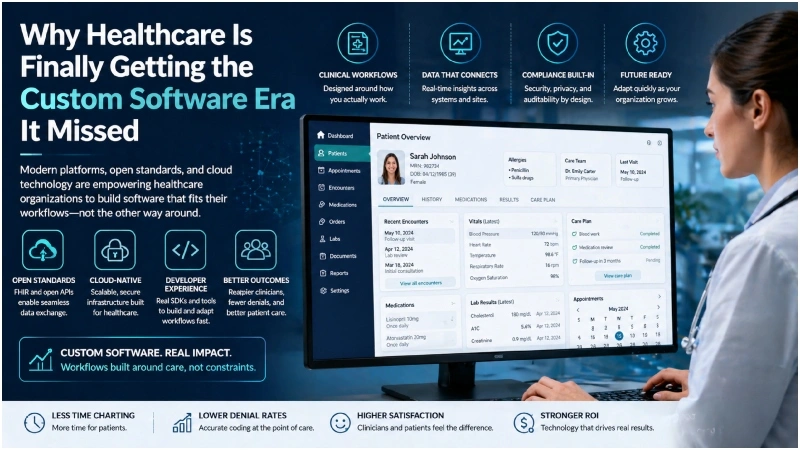
Open clinical data standards. FHIR (Fast Healthcare Interoperability Resources) has become the lingua franca of healthcare data. APIs that used to require painful custom integration now work through standardised resources. A vital-signs reading, a medication order, a referral: each is a predictable object that can move between systems.
Cloud-native primitives. Modern healthcare platforms are built on the same patterns as the rest of enterprise software. Event buses, serverless functions, managed databases, observability tooling. That means new features ship in weeks rather than quarters, and the security and compliance posture inherits decades of cloud best practice.
SDKs and developer experience. The gap between “I need a small workflow change” and “the system supports it” used to be months of vendor tickets. Platforms that expose real SDKs and scripting surfaces let clinical operations teams or in-house developers tailor the system to their real work, not the vendor’s assumptions about it.
For healthcare organisations evaluating this shift, platforms offering custom EMR software with a modern developer surface are where most of the interesting decisions now happen. The choice is no longer between monolithic vendor A and monolithic vendor B. It is between generic platforms and ones that let a clinical team reshape workflows without waiting on a vendor roadmap.
What Customisation Actually Changes
Customisation in this context does not mean cosmetic theming. It means clinical and operational logic.
A busy urgent care chain can build a check-in flow that reflects its actual patient journey. A telepsychiatry group can embed secure video inside the chart rather than taping it to the outside. A fertility clinic can model cycle-specific data structures that a general-purpose EHR would force into free-text notes. A specialty pharmacy can wire its dispensing rules directly into prescribing. None of these require a new vendor. They require a platform that treats the clinical workflow as code rather than as a fixed template.
The downstream effects show up in the numbers most operators care about. Average charting time per encounter falls. Denial rates drop because coding is captured during the visit. Clinician satisfaction improves because the screen finally matches what the job actually involves. Patients, who rarely see the software, still feel the difference in shorter waits and cleaner discharge documentation.
The Build-vs-Buy Question
Customisation opens the old build-versus-buy conversation in a new way. Building a full EMR from scratch remains a bad idea for almost every organisation, because the regulatory surface alone is enormous. Buying a generic EMR and living with its limitations is the default, but it is no longer the only option. The practical middle ground is to buy a modern platform and customise heavily on top of its primitives.
Organisations that succeed with that model tend to share a few habits. They keep a small in-house team that owns the customisation layer. They treat clinical workflows like product surfaces with clear owners and measurable outcomes. They adopt the platform’s version control and deployment tooling rather than making changes through ad-hoc configuration screens. And they accept that the first few months are an investment that pays back over years.
What to Watch For in an Evaluation
A few questions separate platforms built for real customisation from those that advertise it without delivering.
Does the platform expose a stable, documented API surface that covers the majority of clinical objects? Can a developer without vendor hand-holding stand up a new workflow in a sandbox within a day? Is there a real SDK and versioning model, or is customisation limited to form builders and IF/THEN rules? How are updates handled when the underlying platform changes? And, critically, does the vendor have live reference customers running non-trivial custom workflows in production?
Healthcare, Late to the Party
The broader lesson is a familiar one for anyone who watches enterprise software. Every major industry eventually moves from monolithic, vendor-defined systems to composable, customer-shaped ones. Healthcare got there later because the regulatory, clinical, and interoperability costs were higher. The barriers are now lower, and the organisations that move early tend to build compounding operational advantages that are hard to reverse.
Frequently Asked Questions
Is custom software realistic for a small clinic? Yes, when the starting point is a modern platform. A small clinic does not build an EMR from scratch. It picks a customisable platform and tailors the parts that matter most to its specialty.
How is compliance handled when workflows are customised? Most modern platforms separate the compliance-sensitive layer, which remains vendor-managed, from the customisation layer, which sits on top. Audit trails, role-based access, and data retention continue to operate regardless of workflow changes.
What skills does an in-house team need? Usually a small mix of clinical operations, general software engineering, and domain knowledge of healthcare data standards like FHIR.
How long does migration from a legacy EMR typically take? Small practices often move in two to three months. Larger operators plan phased rollouts over six to twelve months, with pilot sites leading the way.
Does customisation make updates harder? It can, if handled poorly. Modern platforms mitigate this by exposing customisations through versioned APIs and SDKs, so upstream updates do not silently break local workflows.