Water has always sat in the quiet corner of the utilities conversation. Electricity grabs headlines, gas follows close behind, and water tends to get noticed only when a bill arrives that nobody was expecting. That is starting to change. In the UK, a combination of market deregulation, smart-metering technology, and cloud-based procurement tools has turned business water into one of the more interesting places where tech and operations meet.
The Deregulated Market That Most People Missed
Since April 2017, every eligible business, charity, and public-sector organisation in England has been able to choose its water retailer, regardless of which wholesaler physically supplies the site. Scotland opened its non-household market even earlier, in 2008. For a country where water was a monopoly for decades, that is a substantial shift.
The practical effect is that two identical offices on the same street can now be on very different contracts, paying different unit rates, with different billing cycles and different levels of service. Businesses that never revisit their setup quietly default to deemed contracts, which are the water equivalent of out-of-contract mobile rates. They work, they are legal, but they sit well above what the market offers.
Where Technology Comes In
Three technology trends have reshaped the back end of business water over the last few years.
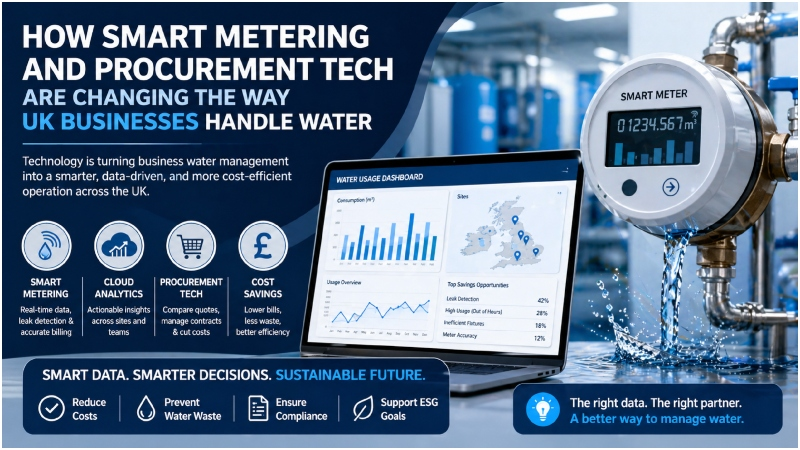
Automated meter reading. Smart water meters transmit consumption data at short intervals, typically every fifteen minutes to an hour, rather than relying on quarterly estimates. For a business, that means leaks, running toilets, and out-of-hours usage show up as anomalies in a dashboard rather than as a surprise on a bill three months later.
Cloud billing and analytics. Modern water retailers surface consumption through a portal that looks more like a SaaS product than a traditional utility bill. Multi-site organisations can compare branches, identify outliers, and flag site-level issues without asking for manual reports.
Procurement platforms. Instead of phoning three retailers and assembling a spreadsheet, businesses now use procurement tools that pull quotes from across the market in one workflow. A typical platform ingests meter data, applies projected usage, and returns comparable offers with clear unit rates and standing charges. Services that help business water procurement through an aggregated panel of suppliers have become a practical default for UK organisations that want a faster, cleaner path to a competitive contract.
The Operational Angle
Tech teams in facilities-heavy organisations already pay attention to energy data because electricity costs are large and volatile. Water tends to be smaller per site, but it adds up across a portfolio, and the operational signal hidden inside the data is often more actionable. A sudden jump in overnight consumption at a single site almost always means a leak. A slow upward drift across a region usually means meter calibration or changes in occupancy. Neither insight is visible in a quarterly PDF.
For organisations running a cloud-first operations stack, modern water data pipes directly into the same dashboards that already carry temperature, occupancy, and energy. The integration is usually lightweight, often a simple API or a CSV export on a schedule. Once the data is in the same place as everything else, water stops being a forgotten line item and starts being part of the normal operational conversation.
What a Sensible Review Looks Like
A useful water review for a UK business usually covers four steps. The first is an audit of the current contract, including unit rate, standing charge, wholesaler, and any legacy terms rolled over from the pre-2017 monopoly days. The second is a consumption baseline over the last twelve to twenty-four months, ideally with seasonal context. The third is a market comparison through a procurement platform. The fourth is a review of meter types and whether an upgrade to smart metering would pay back through leak detection and billing accuracy alone.
Most organisations that go through this find savings between five and twenty percent, depending on how long they have been on a deemed or rollover contract. More importantly, they end up with a data stream they can actually use.
A Small Corner, But a Useful One
Water is never going to be the most exciting topic in a tech meeting. It is, however, one of the areas where operational efficiency, sustainability reporting, and cost control overlap most cleanly. With procurement platforms now routine and smart metering widely available, the cost of running a tighter ship has fallen dramatically. What is left is mostly a question of paying attention.
Frequently Asked Questions
Does market deregulation apply everywhere in the UK? England and Scotland both have open non-household markets. Wales has a partial opening for larger users. Northern Ireland operates under a different framework.
How much can smart water meters actually save? Leak detection alone often returns the cost of an upgrade within a year or two, especially for premises with plumbing that is more than a decade old.
Is switching disruptive? No. The physical wholesaler does not change, so supply is uninterrupted. Only the retailer, billing, and portal change.
How often should a contract be reviewed? Most UK businesses review annually. Multi-site portfolios often align reviews with lease anniversaries or financial year end.
What data do procurement platforms need? Usually the most recent bill, meter reference numbers, and a recent consumption read. Smart meter data, where available, produces the most accurate quotes.