
For years, the way technology companies set pay looked a lot like how small retailers set prices in the 1990s. A senior leader glanced at a few data points, argued about the number in a Slack thread, and committed to a figure that felt defensible. The underlying data was thin, the benchmarks were stale, and the outcome was almost always wrong in at least one direction. Engineers were quietly underpaid, or the company overpaid for a few loud hires, and nobody had the data to know which it was.
That has changed quickly. Modern compensation data is now a category of software in its own right, and tech teams that use it well have turned pay into a decision based on evidence rather than on the last painful counter-offer.
Why Old-School Benchmarking Does Not Work for Tech
Traditional compensation surveys were designed for industries where job titles are stable, skills move slowly, and the main variable is tenure. Technology fits almost none of that. A “senior engineer” in one company sits a level below a “staff engineer” at another. The same title at a Series B startup and at a FAANG means two different jobs, with two different impact expectations and two different comp structures. Stock and bonuses complicate things further because a headline base of £120,000 can represent total comp anywhere from £140,000 to £350,000 depending on the package.
Static annual PDF reports cannot resolve any of that. By the time they are published, the market has moved. By the time they are read, they are stale.
What Modern Compensation Tools Do Differently
A new generation of compensation platforms built for tech companies changed the model in several ways.
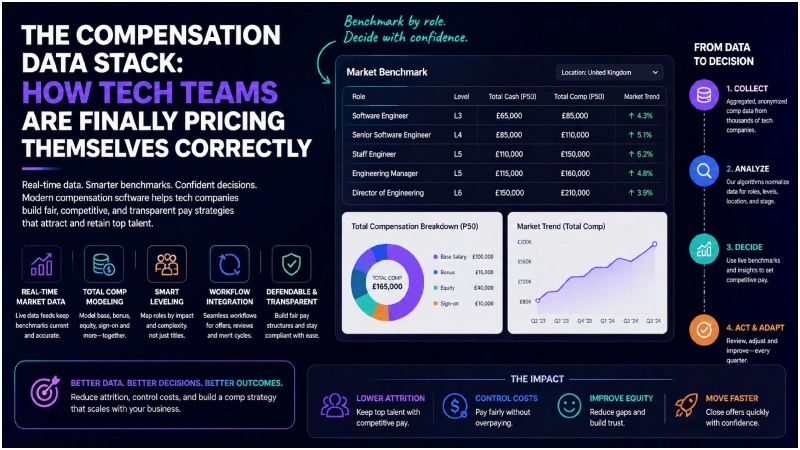
Real-time data feeds. Instead of an annual snapshot, modern platforms pull live data directly from participating companies’ HR systems. The result is a benchmark that reflects the market as it is this quarter, not as it was fifteen months ago.
Total compensation modelling. Base, bonus, equity, sign-on, and refresh grants are modelled together. This is essential in a sector where equity often contributes a third or more of total pay, and where two offers with the same base can be worth meaningfully different amounts over four years.
Levelling maps. Rather than relying on job titles, platforms map roles by scope, complexity, and impact. A Staff Engineer at one company lines up against the equivalent level elsewhere even if the internal title differs, which removes one of the largest sources of benchmark error.
Workflow integration. Offer generation, band reviews, and merit cycles increasingly run inside the comp platform itself, so the data flows straight into decisions rather than sitting in a spreadsheet that someone opens once a year.
Platforms that handle salary benchmarking as a live data product, rather than a periodic report, have become a quiet standard for high-growth companies that want to move fast without breaking their comp philosophy.
The Business Case, From a Technical Perspective
Engineering leaders often ask why compensation benchmarking deserves a dedicated tool when a spreadsheet and a few industry contacts used to do the job. The answer lies in what bad data actually costs.
Regretted attrition. Losing a senior engineer to a counter-offer the company could have matched a year earlier is expensive. Replacement recruiting, onboarding, and ramp often exceed a full year of the salary gap that caused the exit.
Overpaying outliers. Without clean bands, a handful of aggressive hires create internal inequity that spreads as soon as compensation becomes transparent, which in many teams it already is.
Legal and regulatory exposure. Pay-transparency legislation has rolled out across multiple US states and EU member countries, including the EU Pay Transparency Directive. Defensible banding is no longer a nice-to-have.
Speed of decision. Offer cycles that used to take a week of internal negotiation can close in a day when everyone is working from the same live data.
What a Tech Team Actually Does With Compensation Software
A typical modern comp workflow looks something like this. The company defines levelling and bands once, using the tool’s market data as an anchor. New hire offers flow through the same platform, which automatically checks them against band and budget. Annual merit cycles pull current employee comp against market, flag outliers, and produce recommendations. Role families that move faster than the market, such as AI and machine-learning engineering over the last two years, are reviewed more frequently than stable ones.
The output is not perfect comp. Perfect comp does not exist. The output is comp that is defensible, transparent internally, and adjustable in near-real time when the market shifts.
How This Fits Into a Broader Data Stack
For companies already investing in HR analytics, the compensation tool is usually the clearest near-term ROI. It integrates with the HRIS, with the applicant tracking system, and often with finance for headcount planning. The data it produces feeds directly into decisions with large financial consequences, which is not always true of other HR analytics surfaces.
The teams that get the most from these platforms treat compensation as an operational system rather than a once-a-year exercise. Bands are reviewed quarterly. Offer data flows into the platform automatically. Market shifts trigger targeted adjustments rather than sweeping, delayed ones.
The Quiet Transformation
Comp used to be one of the least data-driven functions inside a data-driven industry. The gap was strange and expensive. Closing it has not required any deep innovation, only the decision to treat compensation like every other operational system: instrumented, current, and continuously improved.
For technology teams competing for talent in a market where total packages, geography, and remote policy all interact in complex ways, the companies that get this right quietly pull ahead. The ones that still run comp through gut feel and annual PDFs are watching their best people leave for offers they could have matched.
Frequently Asked Questions
Who contributes the data behind modern compensation platforms? Participating companies submit anonymised, role-level pay data directly from their HR systems. The platform aggregates this into market benchmarks.
How often should bands be reviewed? Quarterly is a common cadence for fast-moving markets, with more frequent spot reviews for hot role families.
Does pay transparency legislation require these tools? Not specifically. It does, however, make defensible bands and clean documentation far more important, which is exactly what these platforms produce.
Is this only for large companies? No. Startups from around fifty employees upward typically see clear ROI, because the cost of one bad compensation decision at that stage is often higher than the cost of the platform itself.
How does this handle equity? Modern platforms model equity alongside base and bonus, accounting for vesting schedules, refresh grants, and preferred-versus-common pricing where relevant.