University years usually come with Pinterest boards of aesthetically pleasing cafés, dreams of being the lead character on a Netflix show, and plans of hosting flatmate movie nights and/or ordering takeout at a moment’s notice. Nonetheless, somewhere between acceptance letters and moving preparations comes the task of securing housing. While it might have been easy enough once upon a time, today, housing is arguably one of the toughest choices students face before stepping into their university years.
The pressure on students’ finances is getting greater each year. Average rental costs for UK student accommodation are estimated to have risen by 7.5% each year since 2021, and there are claims that rents will increase by about 8% this year due to higher demand than supply. On top of this, according to HESA, there were 2.86 million student enrolments in higher education institutions in the UK for 2024/25. Hence, AI and property technology are revolutionising the way students search for and evaluate accommodation options.
Why Student Flat-Hunting Feels More Complicated Than Ever
However, student accommodation research is no longer limited to one question: ‘Is it cheap?’ Students now weigh factors such as transport connections, utility costs, the safety of the surroundings, and proximity to their university before deciding where to live. International students are likely to experience even more pressure, as they usually arrange accommodation prior to their arrival in the UK based solely on online information.
For example, when researching student accommodation in Leicester, most students now take into consideration both price and location. While prices for privately rented accommodation can range from about £760 per month in Leicester, transport tickets can cost about £60 per month, and utilities will cost another £70-£80 per month. In other words, that cheap room suddenly becomes more expensive when you factor in total living costs.
How AI and Prop-Tech Are Transforming the Student Housing Experience
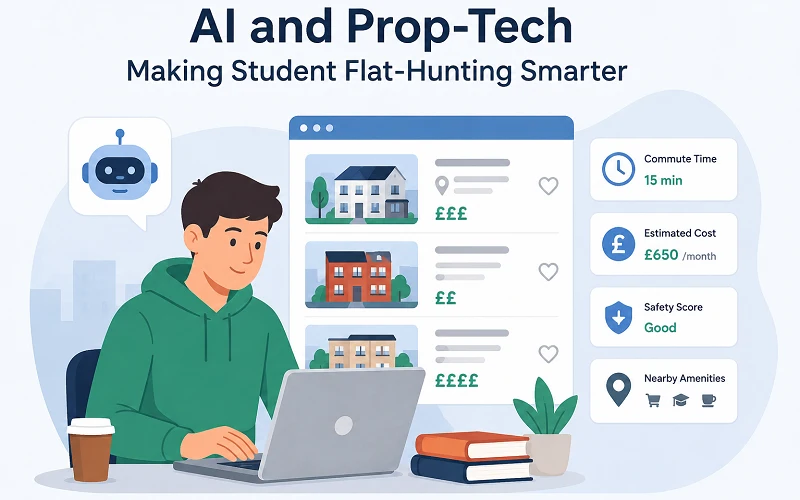
Artificial Intelligence is revolutionising how accommodation can be sought because it provides tailor-made options, much like streaming sites that give tailored film suggestions. Gone are the days when students would spend too much time wading through listings to make decisions based on budget, commuting time, and features. AI technologies are being used nowadays to enable students to browse through different listings in a very short time, calculate their total cost, and, at times, even complete the booking process in a few minutes.
AI technologies have also been adopted to predict demand, customise amenities, report maintenance issues, and even control operations such as lighting and temperature settings. Accommodation businesses have even started using AI chatbots to answer questions from their customers about rental costs, maintenance issues, and move-in dates. Given the increasing use of technology among students, demand for smart, speedy accommodation services is on the rise.
Why Location Still Matters Even When Technology Does the Searching
Even with better housing technologies, location still plays one of the most important roles in influencing the student’s life. Often, students prioritise staying near campus due to increased productivity and lower stress from reduced commuting.
Another element influenced by location is affordability. University of Leicester accommodation, for instance, can cost anything between £69 and £263 per week, depending on whether one opts for basic or more advanced accommodation. Most of these university homes offer residents services such as heating and internet access, which are precisely what students expect from smart housing sites.
Student Accommodation Leicester: How Smart Technology Helps Compare Neighbourhoods Better
The accommodation search process is shifting from considering single rooms to considering whole neighbourhoods. Students checking out student accommodation Leicester will weigh up commuting times, safety levels, available facilities, and even transport access before selecting a place. Two units with the same price can differ greatly in the living experience due to differences in facilities.
Students use AI-based tools to determine what living in the neighbourhood entails, including commuting time, feedback from past students, and local amenities. Students seeking verified accommodation options tend to check UniAcco before settling down. This is due to the need for faster comparisons in light of the 2026 UK student accommodation outlook, in which occupancy levels in prime areas may reach as high as 97%.
What Smart Housing Tools Can Reveal Before You Book a Student Flat
Nowadays, smart accommodation comparison tools are available that offer information that would otherwise require extensive research. This type of comparison can help students make informed decisions and move beyond pictures and promotional information when selecting accommodation. When researching the University of Leicester Accommodation, all of the above information is useful, since there may be significant differences between properties in a similar price range.
| Comparison Factor | Why It Matters | Smart Tool Used |
| Commute time | Impacts daily routine | Route calculators |
| Utility estimates | Helps budgeting | Cost prediction tools |
| Area reviews | Indicates student experience | Rating platforms |
| Safety insights | Supports decision-making | Review analysis |
| Nearby facilities | Improves convenience | Location mapping |
Conclusion
With the help of AI and PropTech technologies, the process of finding student accommodations has become much more efficient. It is now possible to use technology to make comparisons between neighbourhoods, calculate costs, and choose suitable accommodation for students that fits within their budget and needs. This matters especially for the 685,565 international students attending universities in the UK.
However, algorithms cannot know what is right for them. The best accommodation is not just affordable or highly rated, but the one that ensures their academic achievements and development and makes the experience unforgettable outside the classroom. AI can point students toward suitable options, but the final decision remains a personal one.