Nike’s SNKRS app crashed 47 times during high-demand releases in 2022. Not a typo. Forty-seven times in one year.
That number pretty much explains why sneaker brands gave up on the “fastest finger wins” approach. The first-come-first-served model became a disaster, and companies needed something different. Raffles weren’t anyone’s first choice, but they solved problems that were costing brands millions in lost sales and angry customers.
The Old System Was Broken
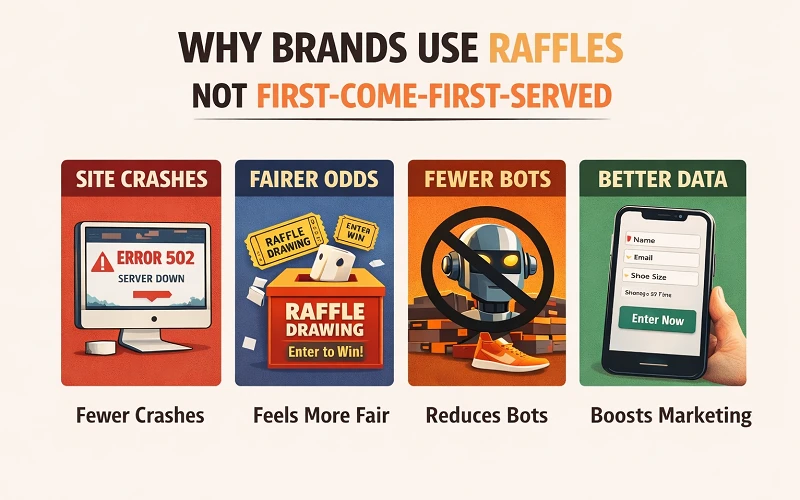
Here’s how drops used to work: a brand announces a release time, everyone shows up at once, and the website immediately falls over. Servers weren’t built to handle 200,000 people hitting refresh simultaneously. They still aren’t, honestly.
The checkout experience was miserable. You’d wait in a virtual queue for 20 minutes, finally get through, and then watch your cart empty because someone else grabbed the last pair. Meanwhile, resellers running automated software had already purchased dozens of units before you even loaded the product page.
Nike admitted that bots made up nearly 60% of traffic during some 2019 releases. Regular people never stood a chance. The whole thing felt rigged because, well, it kind of was.
Brands started looking for alternatives. For those wondering how does shoe raffles work, the system grew directly out of this mess. Companies needed something that wouldn’t crash their servers and wouldn’t make customers feel cheated.
Why Raffles Feel More Fair
The psychology here is interesting. People handle losing a lottery much better than losing a race they were winning.
Research from Harvard Business Review backs this up. Consumers judge fairness by the process, not just the outcome. Getting your cart emptied after 45 minutes in queue? That feels personal. Losing a random drawing? That’s just bad luck.
There’s also a practical angle. Brands can accept entries over 24 or 48 hours instead of cramming everyone into the same 30 seconds. Servers stay up. Support tickets go down. Nobody screenshots an error message to post on Twitter.
The experience still disappoints most entrants (basic math: 500 pairs, 50,000 entries). But disappointment hits different when you knew the odds going in.
Brands Get Something Out of It Too
Raffles aren’t charity work. They’re actually pretty clever from a business perspective.
Every entry is basically a lead form. Name, email, phone number, shoe size, style preferences. Marketing teams can do a lot with that data. A crashed checkout gives you nothing except a headache. A raffle entry gives you a potential customer to retarget for months.
The Federal Trade Commission regulates promotional drawings, which sounds like a hassle but actually helps. Following FTC guidelines signals legitimacy. Brands can point to compliance when customers question whether winners are real.
Some companies add requirements that serve double duty. Nike’s Exclusive Access rewards people who actually use the app and buy products. Requiring in-store pickup for raffle wins cuts down on resellers who don’t live anywhere near the location. These friction points filter out a lot of bad actors.
Bots Adapted (Of Course)
Nobody should pretend raffles fixed the bot problem entirely. Automated systems just evolved.
Instead of speed, operators now focus on volume. Create 500 accounts with different emails and phone numbers. Enter every raffle from each account. The math still works in their favor if entry requirements stay minimal.
The Internet Engineering Task Force has published research on bot detection challenges, and the takeaway isn’t encouraging. Distinguishing real users from sophisticated automation remains genuinely difficult for most websites.
Brands fight back with SMS verification, credit card holds, and sometimes government ID checks. These measures help. Internal estimates suggest raffle systems see about 40% fewer successful bot entries than the old drop model. That’s not a complete solution, but it’s progress.
Where This Goes From Here
Raffles probably aren’t the final answer. But they’re not going away either.
Some brands test weighted systems where loyal customers get better odds. Others experiment with verification tech that makes mass account creation harder. The goal is the same: give real customers a reasonable shot without breaking the website.
Consumer expectations shifted faster than anyone predicted. Yeezy went raffle-only in 2020, and the complaints lasted maybe two months. Now people just expect this format for anything limited.
Brands still using first-come-first-served for hyped releases look like they haven’t updated their playbook since 2015. The raffle model has flaws, sure. But it delivers something the old approach never could: an experience where regular customers don’t feel automatically excluded before the drop even starts.