You live in a world where technology moves fast by default. Software updates roll out weekly. New tools reach millions in months. Speed often signals success, progress, and relevance. In many cases, this approach works.
Bugs can be patched, features adjusted, and systems rolled back with minimal disruption. Fast iteration enables teams to learn quickly and respond to user needs. This approach works best when mistakes are contained. Problems begin when this mindset leaks into systems where failure cannot be undone.
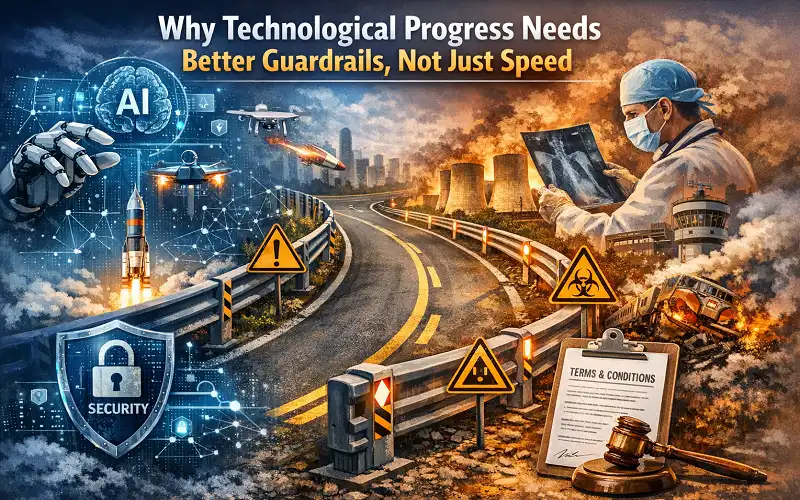
In high-impact sectors, mistakes do not disappear with an update. They linger, compound, and affect real lives, public safety, or national stability. That is where guardrails matter. Not as obstacles to innovation, but as structures that guide progress, reduce harm, and make growth safer, more resilient, and sustainable over time.
When Speed Works and When It Breaks Down
Fast iteration makes sense in consumer technology. If an app crashes, you lose time or convenience. Engineers can fix it and move on. The cost stays limited.
That logic fails in systems tied to national security, infrastructure, or human health. In these areas, failure has lasting effects. Data cannot always be recalled. Physical harm cannot be patched. This risk gap explains why U.S. defense leaders now treat guardrails as enablers, not delays.
Breaking Defense reports that in October 2024, President Biden signed a National Security Memorandum regulating artificial intelligence (AI) use across defense and intelligence agencies. The policy mandates classified testing, a formal risk management framework, and strict limits on high-impact uses.
Officials emphasized that agencies adopt AI more quickly when rules are clear, not vague. The guidance also requires human control over nuclear decisions and regular updates as systems evolve. Speed without boundaries works only when risk stays small.
In defense and intelligence systems, the stakes rise immediately. That is why guardrails become essential.
Healthcare Tech Shows Why Guardrails Matter Most
Healthcare technology blends software, data, and biology. Each layer carries uncertainty. When innovation accelerates, oversight often struggles to keep pace. Many health tools now follow business-style rollout cycles. Access and scale come first. Long-term outcomes surface later.
Newsweek reports that health system leaders now feel pressure to adopt AI and predictive tools quickly, but fear disrupting patient care. Executives told Newsweek they prefer pilots and proof-of-concept testing, since errors in clinical systems can cause harm that refunds or fixes cannot reverse.
This gap becomes visible after widespread use. Safety concerns emerge through long-term data, patient outcomes, and legal scrutiny. The Oxbryta lawsuit reflects this pattern. It involves claims focusing on serious complications that surfaced after the sickle cell drug reached broad clinical use.
Legal reviews of post-approval drug safety have highlighted similar concerns. TorHoerman Law explains that Oxbryta was approved for increasing hemoglobin levels, with safety concerns emerging only after broader patient exposures. The case underscores how risks can remain hidden during approval but become visible once actual patients are affected.
Healthcare cannot rely on the same trial-and-error culture as consumer tech. Lives depend on restraint, review, and accountability.
Techno-Optimism Is Fueling Risk Blindness
Many developers and investors believe technology can solve nearly any problem it creates. Scholars describe this belief as techno-optimism.
The Conversation explains that this ideology gained renewed attention after a 2023 manifesto by venture capitalist Marc Andreessen. He argued that more technology is the answer to every material challenge, from energy to democracy. Researchers note that techno-optimism frames guardrails as unnecessary friction.
Regulations and precautions are often dismissed as resistance to progress. Social and ethical costs become short-term obstacles that future tools should fix. You see this thinking when leaders promise updates will address harm later. The issue is timing. Damage usually happens before fixes arrive.
The Conversation also points to social media as a clear example. Platforms were promoted as solutions to isolation and access gaps. Over time, they exposed deeper structural problems that technology alone could not solve. When optimism replaces planning, systems scale without understanding impact, trust fades, and users grow cautious.
As a result, oversight often follows after harm occurs. Guardrails exist to replace blind faith with foresight.
Guardrails Are Already Shaping High-Impact Tech
You can see guardrails forming across industries. They are not theoretical ideas. They respond to real limits that unchecked growth exposes.
This shift is evident in energy planning for AI infrastructure. The National Interest reports that AI data centers operate nonstop and require heavy power and cooling. Without clear standards for energy sourcing and siting, this demand could strain clean power supply, raise costs for other users, and slow decarbonization efforts.
This pressure also appears in transportation safety as electric vehicles are becoming heavier. The Hill reports that many EVs weigh over 1,000 pounds more than gas vehicles, pushing highway guardrails beyond their design limits.
Recent crash tests showed electric trucks breaking through barriers, prompting calls to update safety standards as EV adoption continues to rise. These challenges reflect a broader pattern in how technology is developed.
MIT Sloan Management Review reports that most organizations lack a structured process to assess potential harm before launch. Managers often prioritize market goals early, while safety and ethical risks surface only after systems are already deployed.
Together, these examples point to the same conclusion. Guardrails help systems last, protecting users and markets.
People Also Ask
1. Can technology guardrails actually improve innovation speed?
Not necessarily. While they require upfront planning, guardrails actually accelerate long-term growth by preventing catastrophic failures. They reduce the “fear of failure” that keeps projects stuck in pilot stages. Clear rules provide a stable roadmap, enabling developers to scale safely without frequent, expensive backtracking.
2. What is the “pacing problem” in modern technology development?
The pacing issue occurs when innovation develops much faster than the laws meant to govern it. This creates regulatory gaps where harmful tools scale globally before safety standards are set. Without proactive oversight, we risk widespread privacy breaches and security vulnerabilities that become significantly harder to correct after they occur.
3. Why is human oversight necessary for advanced AI systems?
Human oversight ensures that machines do not make final decisions in life-or-death scenarios, like medical surgeries or national defense. It provides a moral safety net that algorithms lack. By keeping people involved, we ensure accountability and allow for nuanced judgment when complex, unforeseen, or dangerous situations arise.
Final Thoughts
You do not need to slow innovation to make it safer; you need direction. Guardrails provide technology with the room to grow without breaking trust. That said, speed still matters. But unchecked speed creates fragile systems.
In high-impact fields, resilience breeds success. The next phase of progress will favor builders who plan for consequences. Thoughtful limits are not resistance to change. They are how change survives.