
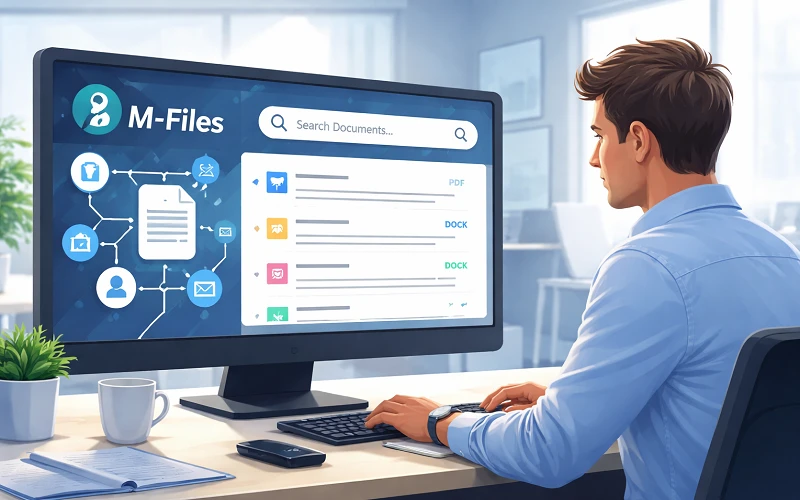
In the realm of business, the ability to swiftly locate and manage documents is a game-changer for operational efficiency. Recent surveys show that employees spend 20% of their work week searching for internal information or tracking down colleagues who can help with specific tasks. By integrating the M-Files connector for search capabilities, businesses can reduce this time significantly, thereby increasing productivity.
Valuable search functionality can transform an organization’s data retrieval processes, ensuring that critical information is just a few clicks away. In this article, you’ll discover how utilizing the M-Files connector can streamline workflows, facilitate collaboration, and enhance document management strategies.
Leveraging M-Files Connector for Enhanced Search Capabilities in Business
Introducing M-Files Connector into your business infrastructure can exponentially improve the precision and speed of document searches. With its advanced metadata-driven search capabilities, M-Files enables users to locate files based on content, context, and relevancy more efficiently than traditional folder-based storage systems.
This transition to a more intelligent search method reduces time spent sifting through irrelevant documents and increases the likelihood of finding the exact content needed. Numerous case studies have demonstrated that companies leveraging M-Files for search purposes have seen a dramatic reduction in time spent locating documents by as much as 35-50%.
To ensure optimal use of the M-Files Connector, businesses should conduct regular staff training sessions. This empowers users to understand different search techniques and increases user adoption, ensuring that the organization reaps the full benefits of the integration. Businesses can take advantage of the m files connector for search from BA Insight to enhance their search capabilities.
Streamlining Document Management with M-Files Connector
M-Files Connector goes beyond search; it’s a comprehensive solution that streamlines entire document management processes. By using metadata to categorize and manage documents, it ensures that all files are organized systematically without the constraint of folder structures.
With this innovative approach, document retrieval becomes an intuitive process, and the system can even suggest relevant documents based on user behavior or project context. Importantly, by minimizing the reliance on manual categorization, the risk of human error is significantly lowered, which enhances document accuracy and compliance.
Businesses can capitalize on this efficiency by integrating M-Files Connector with their existing systems through APIs to allow for seamless user experiences. It’s advisable to assess your current document management procedures before implementation to understand how M-Files can best complement and optimize your organization’s workflows.
Overcoming Challenges in Data Retrieval with M-Files Search Integration
Data retrieval can often be a bottleneck in business operations, but M-Files Connector addresses this head-on by offering a sophisticated search integration. It resolves issues like duplicated content and legacy data siloes, allowing for a more streamlined retrieval process.
Implementing M-Files can also significantly enhance compliance and audit readiness by providing comprehensive search logs and maintaining access controls. This is especially critical for businesses in industries that are heavily regulated or have strict data governance requirements. Digital document management has become indispensable in upholding rigorous regulatory standards.
To overcome common challenges in data retrieval, ensure your M-Files search integration is tailored to your organization’s specific needs. This might involve customizing metadata structures or setting up refined permission levels to maintain data security while optimizing access.
Maximizing Collaboration and Productivity Using M-Files for Advanced Search Functions
One of the most potent advantages of implementing M-Files Connector is the opportunity it offers to maximize collaboration and productivity. As remote work becomes increasingly common, the need for tools that foster efficient team communication and document sharing has never been more pressing.
The connector’s version control and checking in/out features are instrumental in ensuring team members are always working on the latest document without overwriting each other’s work. Moreover, its compatibility with numerous third-party tools and apps means it can easily become part of a larger ecosystem of productivity tools within an organization. Productivity app best practices are vital to this kind of integration.
To maximize these benefits, it’s essential to establish clear protocols around document and information sharing within M-Files. Encouraging open communication channels and scheduled check-ins can help ensure that everyone is on the same page, both literally and figuratively.
Wrap Up
Ultimately, the M-Files connector emerges as a valuable tool for businesses aiming to bolster their search capabilities, document management efficiency, and collaborative dynamics. By leveraging its advanced search functions and intake process, organizations can alleviate the burden of manual document retrieval and management, permitting staff to better focus on core business activities.
It’s a step towards creating a more organized, accessible, and efficient digital workspace that can adapt to the changing demands of today’s workforce.